Ductwork leaks silently drain your energy budget and compromise the air quality in your home. Most homeowners don’t realize how much conditioned air escapes through gaps and cracks in their duct systems, leading to higher utility bills and uneven temperatures throughout the house.
A thorough ductwork leak inspection reveals exactly where your system is losing efficiency. We at IE Drone Services help property owners identify and address these problems before they become expensive headaches.
Why Ductwork Leaks Cost You Money and Comfort
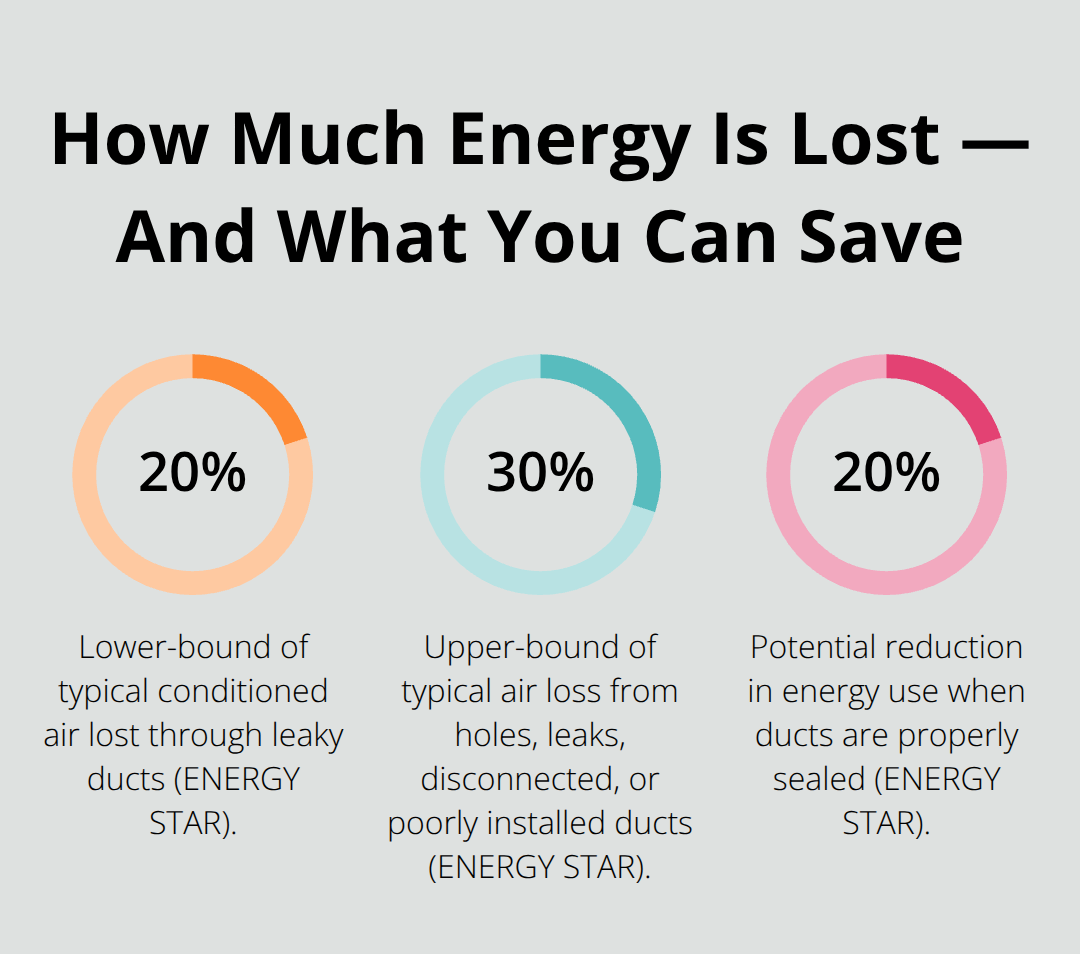
Ductwork leaks drain your energy budget and compromise comfort throughout your home. According to ENERGY STAR, a typical home loses between 20 and 30 percent of conditioned air due to holes, leaks, disconnected ducts, and poorly installed ductwork. This loss translates directly into higher utility bills.
If your energy costs have climbed without a corresponding rate increase from your utility company, leaky ducts are often the culprit. The problem intensifies in summer and winter when your HVAC system works hardest to maintain comfort.
Temperature Swings and Uneven Comfort
Rooms that feel consistently hotter or colder than the rest of your home signal that ductwork is not distributing air evenly. This uneven temperature distribution frustrates homeowners and forces HVAC systems to run longer cycles, wasting additional energy. Leaky ducts pull dust, insulation particles, and fumes from basements, attics, and crawl spaces directly into your living areas. ENERGY STAR research shows that sealed ductwork improves indoor air quality by preventing household and garden chemicals, insulation debris, and outdoor pollutants from circulating through your home. This matters especially for people with asthma or allergies, as reducing duct leakage minimizes pollutants that trigger symptoms.
The Hidden Safety Risk
Leaky ducts create a serious safety risk through backdrafting, which pulls combustion gases like carbon monoxide back into living spaces. Sealing these leaks protects your family while lowering your heating and cooling costs simultaneously. The dual benefit-improved safety and reduced energy waste-makes duct sealing a priority for any homeowner concerned about household health.
Where Leaks Hide in Your Ductwork
Ductwork exists in two forms: exposed systems in basements, attics, or crawl spaces, and hidden systems running through walls and ceilings. Exposed ducts are easier to inspect visually (look for holes, gaps at connections, and feel for escaping air on larger leaks). Flexible ducts are particularly prone to disconnection and collapse, while rigid metal ducts develop corrosion and seam failures over time. Hidden ducts demand professional assessment because leaks behind walls or above ceilings remain invisible until an expert locates them. Thermal imaging and infrared technology detect energy leaks that standard visual inspection cannot reveal, identifying exactly where conditioned air escapes so you know precisely what needs repair.
Finding Leaks Your Eyes Cannot See
Visual Inspection: The First Step
Visual inspection catches obvious problems, but most ductwork leaks hide where you cannot reach them. Start by examining exposed ducts in basements, attics, and crawl spaces for visible holes, gaps at connection points, and signs of disconnection. Feel around larger sections with your hand to detect escaping air, particularly where flexible ducts meet rigid sections or where ducts connect to supply registers. This tactile approach works for obvious leaks, but it misses the majority of problems in your system.
Quantifying Leaks with Professional Testing
Duct leakage testing uses a calibrated fan pressurized at 25 Pascals to measure airflow and quantify exactly how much air escapes from your system during normal operation. A reading of 120 cfm25 means your ducts leak 120 cubic feet of air per minute at that test pressure, providing a concrete number to track improvements after repairs. Professional duct leakage testing distinguishes between malignant leaks that escape to the outdoors and benign leaks that remain inside your conditioned space. Outside leaks directly waste conditioned air and pull unconditioned air inward, making them your highest priority for sealing.
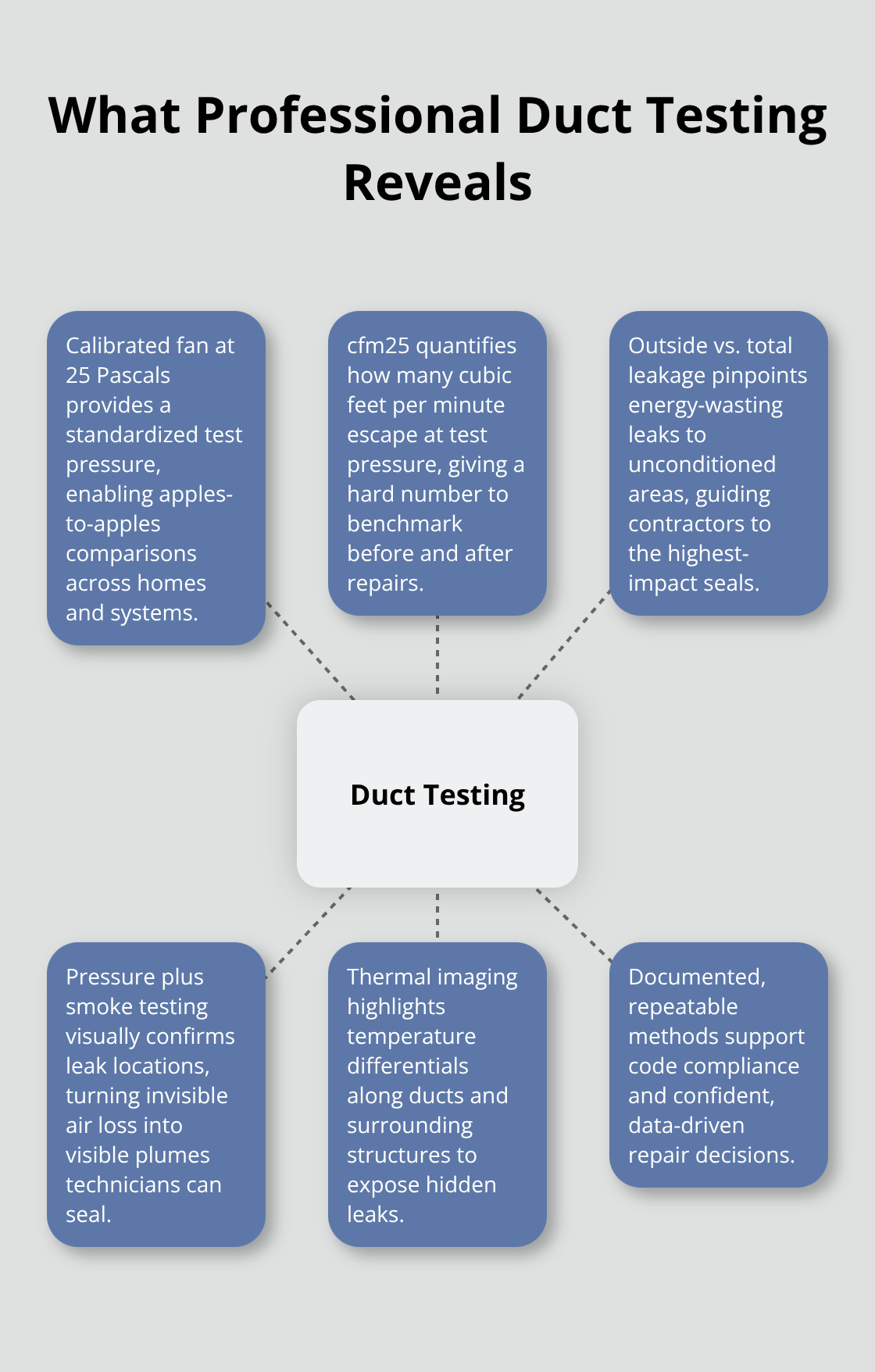
Total leakage testing measures all leaks in the system, then comparing that figure to outside-only leakage reveals how much escapes internally. This two-part approach helps contractors target repairs where they deliver maximum energy savings.
Thermal Imaging and Pressure Testing
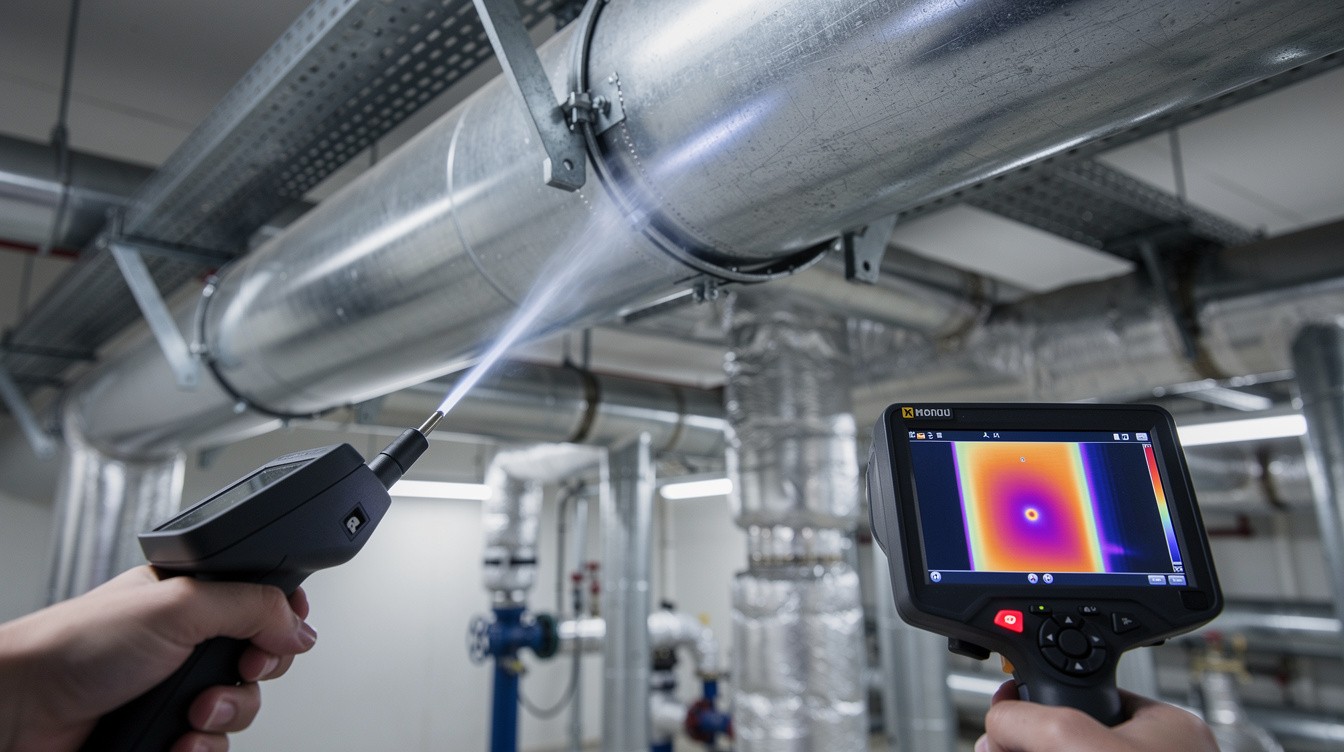
Thermal imaging and infrared technology reveal energy leaks that visual inspection cannot detect, identifying exactly where conditioned air escapes through walls, ceilings, and concealed sections. This technology shows temperature differentials across your ductwork and surrounding structures, exposing leaks in hidden ducts before they waste thousands in energy costs. Pressure testing combined with smoke testing identifies the exact location of leaks (introducing visible smoke into the ductwork while maintaining pressure allows technicians to see precisely where air escapes). Energy Vanguard documents standardized procedures using calibrated equipment for accurate, repeatable results that support code compliance and inform repair decisions.
Investment in Accurate Data
Professional testing costs between three hundred and eight hundred dollars depending on system size and complexity, but the data justifies the investment by preventing costly repairs to the wrong sections. Once you have baseline measurements from professional testing, future inspections track whether sealing work actually improved performance, providing accountability that DIY approaches cannot match. This concrete data transforms your repair strategy from guesswork into precision targeting, ensuring every dollar spent on ductwork repairs addresses the leaks that matter most.
How to Seal and Repair Ductwork Leaks
DIY Sealing for Visible Problems
Minor ductwork leaks in exposed sections respond well to targeted sealing without professional intervention. Metal tape or masking tape applied directly over small holes and gaps stops air escape immediately, though ENERGY STAR warns that duct tape degrades within five years and should never serve as a permanent solution. For flexible ducts that have disconnected from rigid sections, reattach them and wrap the joint with mastic sealant (a putty-like compound) to create an airtight connection that lasts far longer than tape alone. Mastic costs roughly fifteen to thirty dollars per gallon and covers approximately seventy-five linear feet of ductwork seams. If you handle minor sealing yourself, prioritize accessible joints in basements and attics where you can inspect the work afterward to verify the seal held. This approach only addresses visible problems, however, leaving the majority of your leakage untouched.
Professional Sealing for Hidden Leaks
Professional sealing tackles hidden leaks that DIY methods cannot reach and delivers measurable results that justify the investment. Aeroseal technology uses a patented, non-toxic aerosol sealant that pressurizes duct systems, driving sealant particles directly to leaks to seal them from the inside without opening walls or ceilings. This method provides results lasting approximately forty years when properly applied, making it substantially more durable than surface patching. The aerosol sealant reaches leaks in concealed sections that visual inspection cannot locate, addressing the energy waste that matters most to your utility bills.
When Replacement Becomes Necessary
Significant ductwork damage such as crushed flexible ducts, severe corrosion in metal sections, or improperly sized ducts requires actual replacement rather than sealing alone, typically costing two to five thousand dollars depending on system scope. A professional assessment determines whether your ducts need repair, sealing, or replacement, preventing unnecessary spending on the wrong solution. Thermal imaging and infrared cameras pinpoint exactly where your energy leaks occur, eliminating guesswork and directing repair efforts toward the highest-impact problems. Once you know precisely which sections need attention, contractors can quote repairs with confidence rather than estimating costs for exploratory work.
Preventive Maintenance Between Inspections
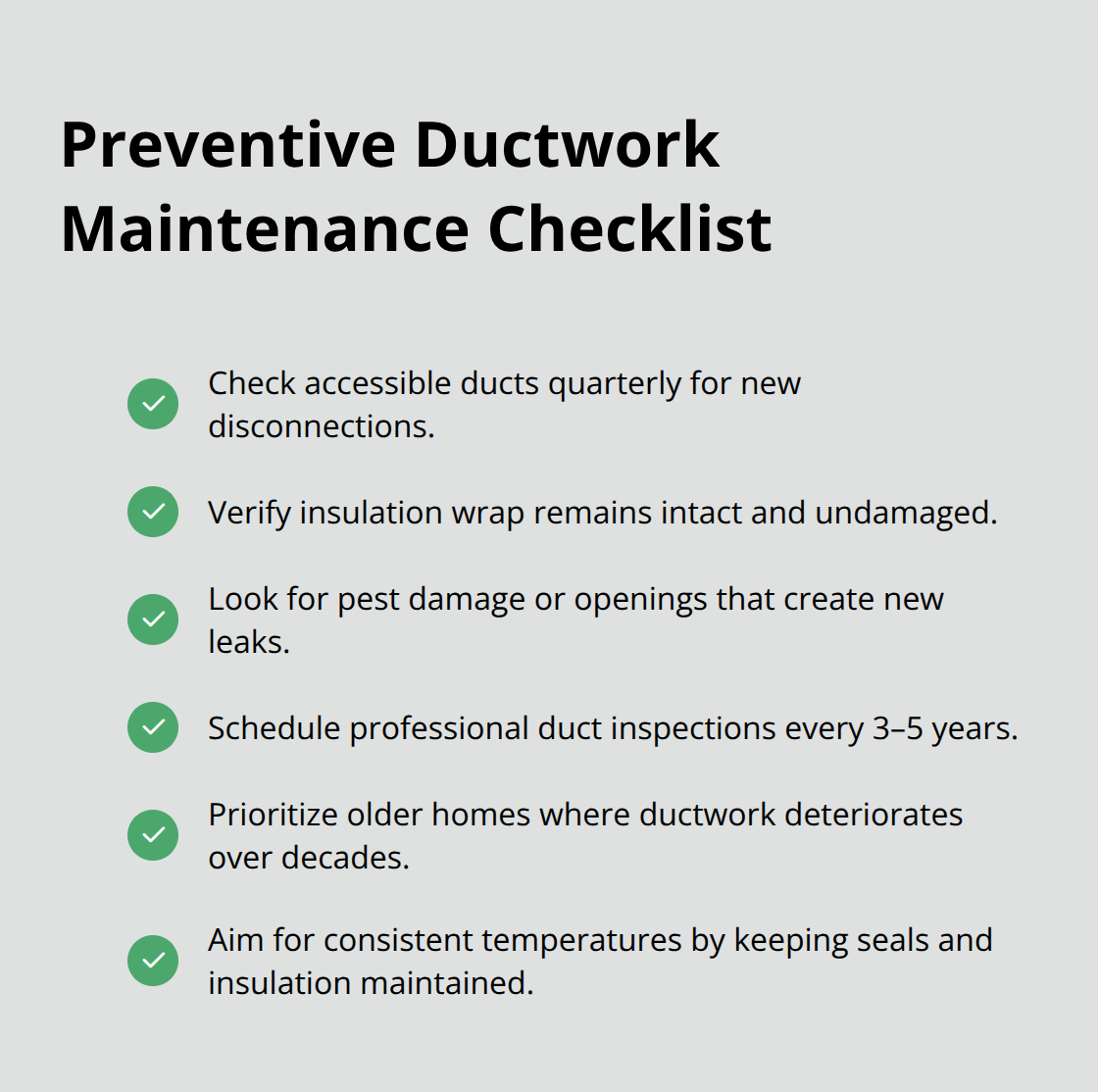
Preventive maintenance between inspections means checking accessible ducts quarterly for new disconnections, verifying that insulation wrap remains intact, and ensuring no pest damage has created new openings. Scheduling professional duct inspections every three to five years catches developing problems before they waste significant energy, particularly in older homes where ductwork deteriorates gradually over decades. This proactive approach protects your investment in your HVAC system and maintains consistent comfort throughout your home.
Final Thoughts
Ductwork leaks drain your energy budget silently, but a professional ductwork leak inspection stops the waste immediately. Visual inspection catches obvious problems in exposed ducts, while professional duct leakage testing quantifies exactly how much air escapes from hidden sections. Thermal imaging reveals energy leaks behind walls and ceilings, pressure testing pinpoints their exact locations, and smoke testing confirms where air exits your system.
Sealed ducts reduce energy consumption by up to 20 percent according to ENERGY STAR, lowering your utility bills substantially while improving comfort by eliminating temperature swings between rooms. Better indoor air quality follows immediately as sealed ducts prevent dust, insulation particles, and chemical fumes from basements and attics from entering your living spaces. Sealed ducts also eliminate the backdrafting risk that allows carbon monoxide to enter your home, protecting your family’s safety while extending your HVAC system’s lifespan.
Contact IE Drone Services to schedule your thermal building inspection and identify exactly where your ducts lose conditioned air. Our FAA-certified team uses thermal imaging and infrared cameras to detect energy leaks that standard visual inspection cannot reveal, providing precise data that guides repair decisions. We deliver actionable results that prevent wasted spending on the wrong solutions.