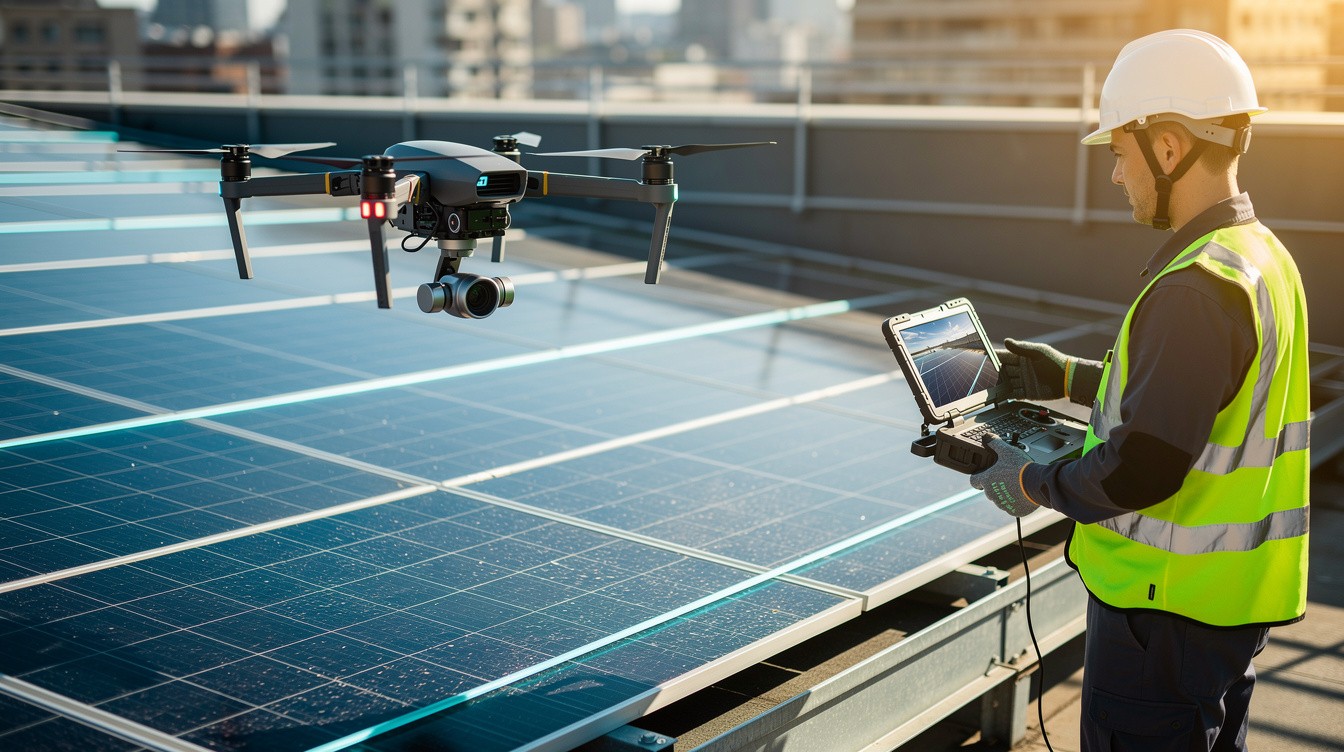
Solar panels are a significant investment, and their performance directly affects your energy savings and system lifespan. Most solar owners don’t realize that dirt, debris, and micro-damage can silently reduce output by 15-25% without any visible warning signs.
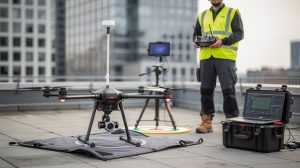
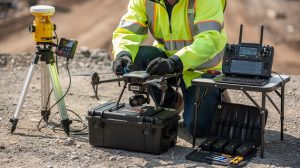
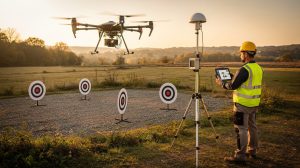
At IE Drone Services, we use aerial solar inspection services to catch these issues before they cost you thousands in lost energy production. Our high-resolution drone technology identifies problems that ground-based inspections simply miss.
Why Your Solar Panels Are Losing Money Right Now
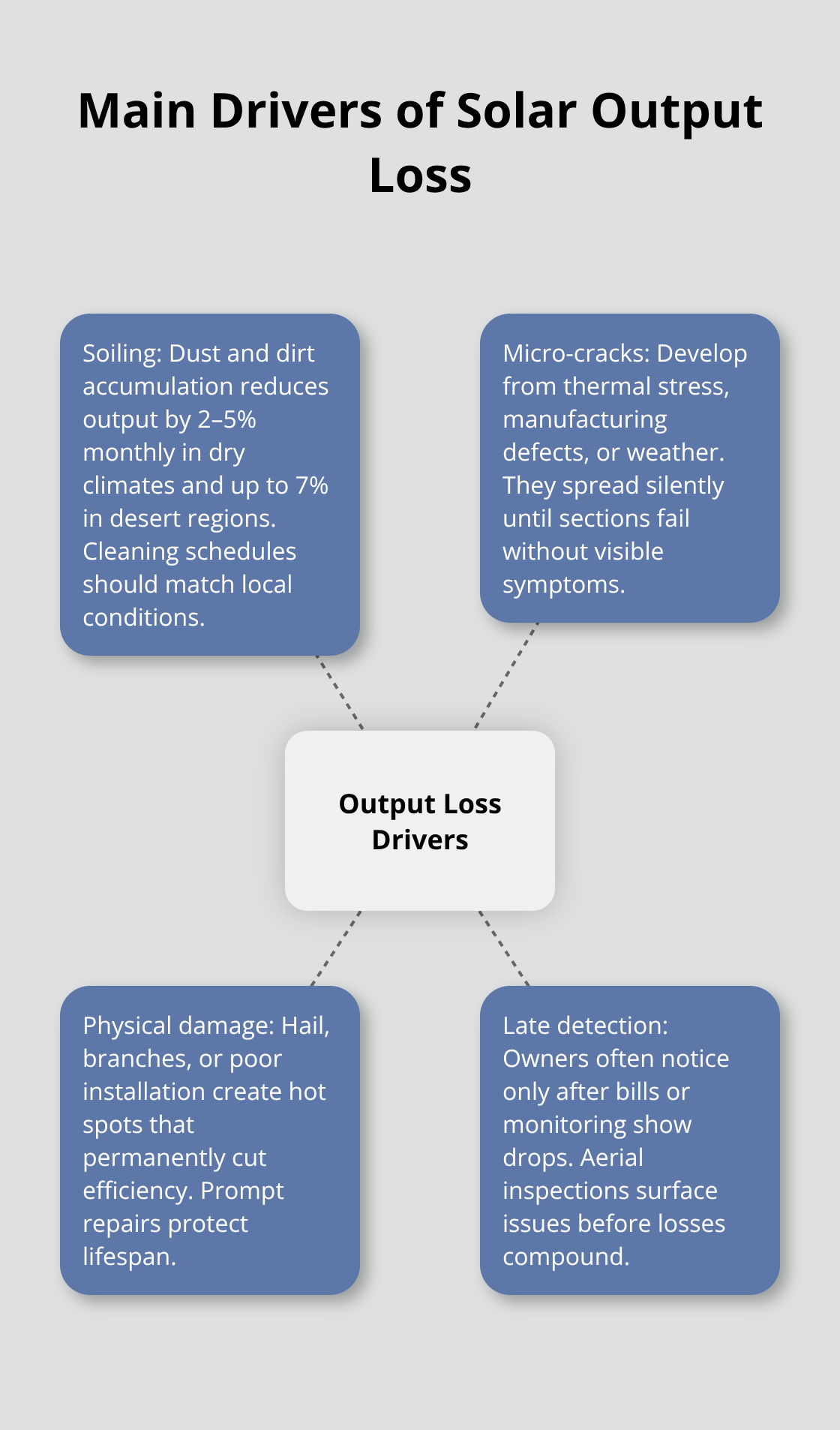
Solar panel degradation happens faster than most owners expect, and the culprits are specific and measurable. Dust and dirt accumulation reduces output by 2-5% monthly in dry climates, according to research from the National Renewable Energy Laboratory. In desert regions, that figure climbs to 7% monthly. Micro-cracks in cells develop from thermal stress cycles, manufacturing defects, or weather damage, and they spread silently without visible symptoms until entire sections fail. Physical damage from hail, fallen branches, or poor installation creates hot spots that permanently reduce panel efficiency and shorten lifespan. Most solar owners discover these problems only when their energy bills stop improving or their monitoring system shows unexplained output drops-by which point thousands in energy production have already vanished.
Dirt and Debris Reduce Output Faster Than You Think
Soiling is the industry term for performance loss from environmental contamination, and it’s the most preventable drain on your system. A solar array covered in dust, bird droppings, or pollen can lose 15-25% of its output. The timing matters: panels installed in spring accumulate debris throughout summer, hitting peak contamination levels by fall. Agricultural areas, construction zones, and regions near highways experience soiling rates two to three times higher than average suburban installations. Standard ground-level cleaning reaches only the lower portions of your array and misses the micro-level buildup on top surfaces where sunlight actually enters the cells. High-resolution aerial imaging reveals exactly where contamination concentrates, allowing targeted cleaning that costs far less than cleaning an entire array unnecessarily.
Thermal Stress and Electrical Failures Need Early Detection
Temperature cycling causes solder joints to crack and cell interconnects to separate, reducing power output incrementally until a complete string fails. Infrared imaging from aerial inspections detects hot spots and temperature anomalies that ground-based visual inspections cannot identify. A single underperforming module can drag down the efficiency of an entire string, multiplying losses across your system. Delamination (where the protective layers separate from silicon cells) traps moisture inside and accelerates failure. These electrical and structural problems require intervention before they cascade into costly repairs or panel replacement. Professional aerial inspections capture thermal data and high-resolution imagery simultaneously, giving you a complete picture of system health before problems escalate beyond repair.
What Ground-Based Inspections Miss
Walking your roof with binoculars or a handheld camera captures only surface-level observations. Ground inspectors cannot access the top surfaces of panels safely or efficiently, and they cannot detect temperature variations that indicate internal electrical failures. Manual inspections also take hours or days for large arrays, keeping your system offline or requiring multiple visits. Aerial drone technology (equipped with high-resolution and infrared cameras) covers your entire array in a single flight, collecting data that reveals problems invisible to the naked eye. The combination of thermal and visual data creates a comprehensive inspection report that identifies specific panels, their exact locations, and the nature of each defect. This precision allows you to prioritize repairs and avoid unnecessary maintenance on panels that are performing normally.
How Aerial Drones Outperform Ground-Based Solar Inspections
Safety and Speed Transform Inspection Operations
Aerial drone inspections eliminate the physical dangers and time constraints that make ground-based solar assessments impractical for large installations. A technician climbing onto a residential roof to inspect a 10-kilowatt array risks falls, heat exposure, and equipment damage-problems that disappear when you deploy a drone instead.
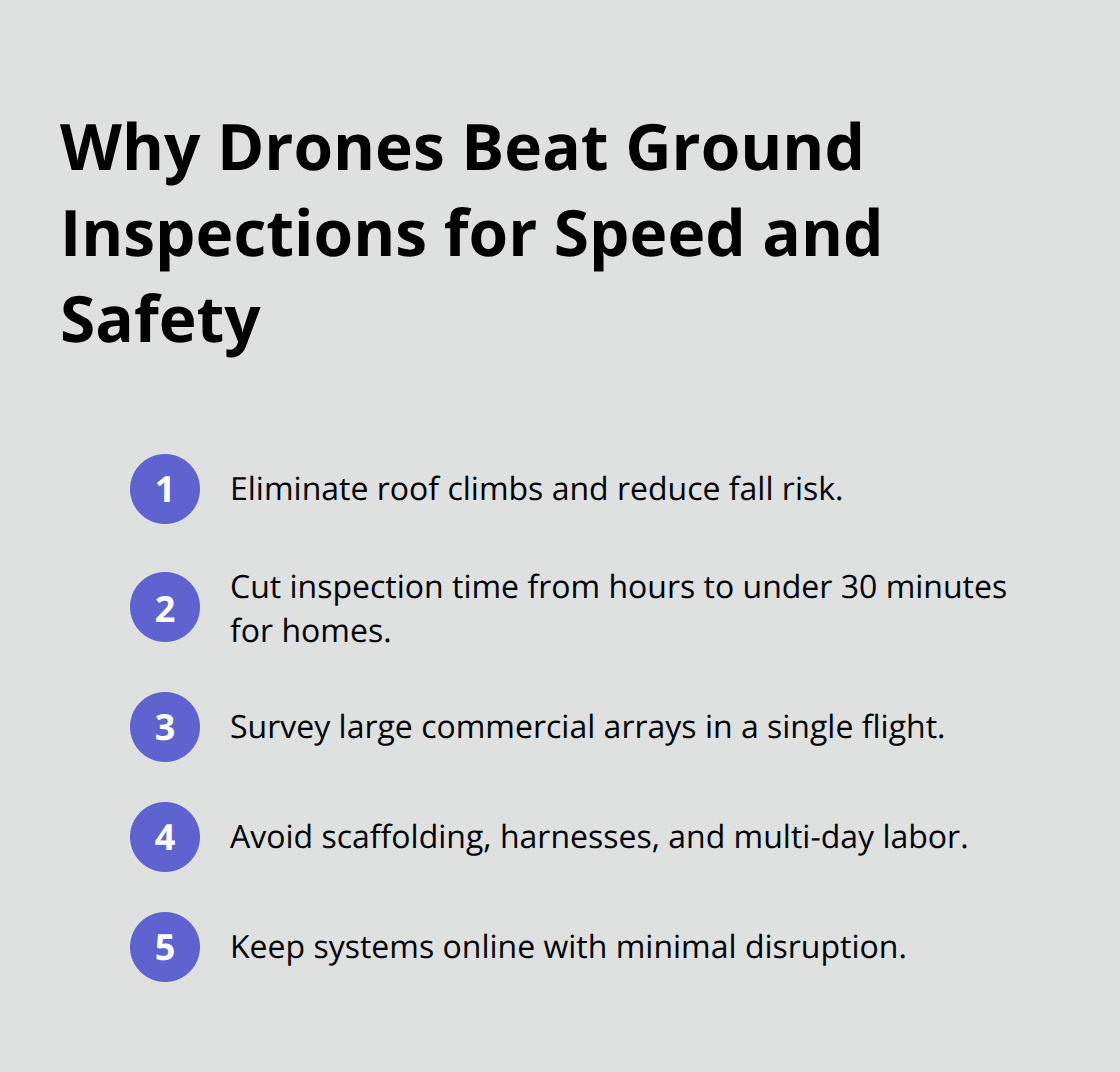
What takes a ground crew four to six hours across multiple visits happens in under 30 minutes with aerial technology. For commercial arrays spanning thousands of square meters, the difference becomes stark: a ground inspection requires scaffolding, safety harnesses, and multiple days of labor, while a drone completes the same job in a single flight without anyone leaving the ground.
High-Resolution Imaging Reveals Hidden Defects
The data quality difference is what actually changes how you maintain your system. High-resolution cameras mounted on professional drones capture images at 20-megapixel clarity or higher, revealing hairline cracks, solder defects, and moisture intrusion that would be invisible from ground level. Thermal infrared sensors simultaneously map temperature variations across every panel, identifying electrical faults and connection problems before they cascade into string failures. This dual-layer data collection-visual plus thermal-creates a diagnostic picture that ground inspections simply cannot match. A technician with binoculars sees a panel. A drone sees the panel’s structural integrity, electrical performance, and exact degradation patterns in a single pass.
Cost Savings Through Precision Targeting
Ground-based inspections cost between $500 and $2,000 depending on array size and roof complexity, with prices climbing sharply for systems larger than 25 kilowatts or installed on difficult-to-access surfaces. Drone inspections typically cost $300 to $800 for comparable coverage, representing a 40 to 60 percent reduction in inspection expense. More importantly, the detailed imagery and thermal data allow you to prioritize repairs based on actual degradation severity rather than guessing which panels need attention. If your array shows 12 underperforming modules out of 300, you know exactly which ones to service and can schedule targeted maintenance instead of blanket cleaning or premature replacements. This precision prevents unnecessary spending while addressing genuine problems immediately.
Why Precision Data Matters for Your Bottom Line
Detailed inspection reports identify specific panels, their locations, and actionable repair priorities. When you know what’s actually wrong with your system, you stop wasting money on maintenance that doesn’t matter and start fixing the defects that drain your energy production. The next step involves understanding how to interpret these reports and choose the right inspection provider for your specific array size and complexity.
Getting Started With Aerial Solar Inspections
Assess Your Array Size and Installation Complexity
Your solar array size and installation complexity directly determine whether professional aerial inspection becomes practical or remains optional. Residential systems under 10 kilowatts installed on straightforward single-slope roofs can sometimes rely on visual monitoring and periodic cleaning, but this approach misses the thermal and structural defects that reduce output by 15-25% annually. Systems larger than 15 kilowatts, installed on complex roof geometries, or located in high-soiling regions (agricultural areas, industrial zones, or desert climates) absolutely benefit from professional drone inspection because ground-based assessment becomes too time-consuming or unsafe. Commercial installations exceeding 50 kilowatts should schedule annual aerial inspections as standard maintenance, since a single underperforming string can cost thousands in lost energy production before anyone notices.
The decision hinges on a simple calculation: if your array cost more than $50,000 to install, spending $300-800 on a comprehensive drone inspection that identifies problems worth $5,000-15,000 in repairs or efficiency gains becomes financially obvious.
Avoid DIY Drone Services and Consumer-Grade Equipment
DIY drone services marketed to solar owners create more problems than they solve. Consumer-grade drones lack the thermal imaging sensors necessary to detect electrical faults, and footage captured by untrained operators produces images too blurry or poorly angled to identify micro-cracks and delamination. Professional providers combine FAA-certified pilot expertise with high-resolution and infrared camera systems designed specifically for solar diagnostics, delivering reports that pinpoint exact panel locations, defect types, and repair priorities in actionable detail.
A professional inspection report specifies which of your 300 panels underperforms, what defect caused the degradation, and whether the issue demands immediate repair or can wait six months. This precision eliminates guesswork and prevents spending $2,000 on unnecessary array cleaning when targeted maintenance on three panels would restore 90% of lost output.
Choose a Provider That Delivers Actionable Data
Reputable providers deliver data within 48-72 hours, include thermal analysis showing temperature variations across your array, and explain findings in plain language rather than technical jargon that leaves you confused about what actually needs fixing. The inspection report should identify specific panels by location, describe the nature of each defect (micro-cracks, delamination, hot spots, or soiling patterns), and recommend repair priorities based on severity and cost-benefit analysis.
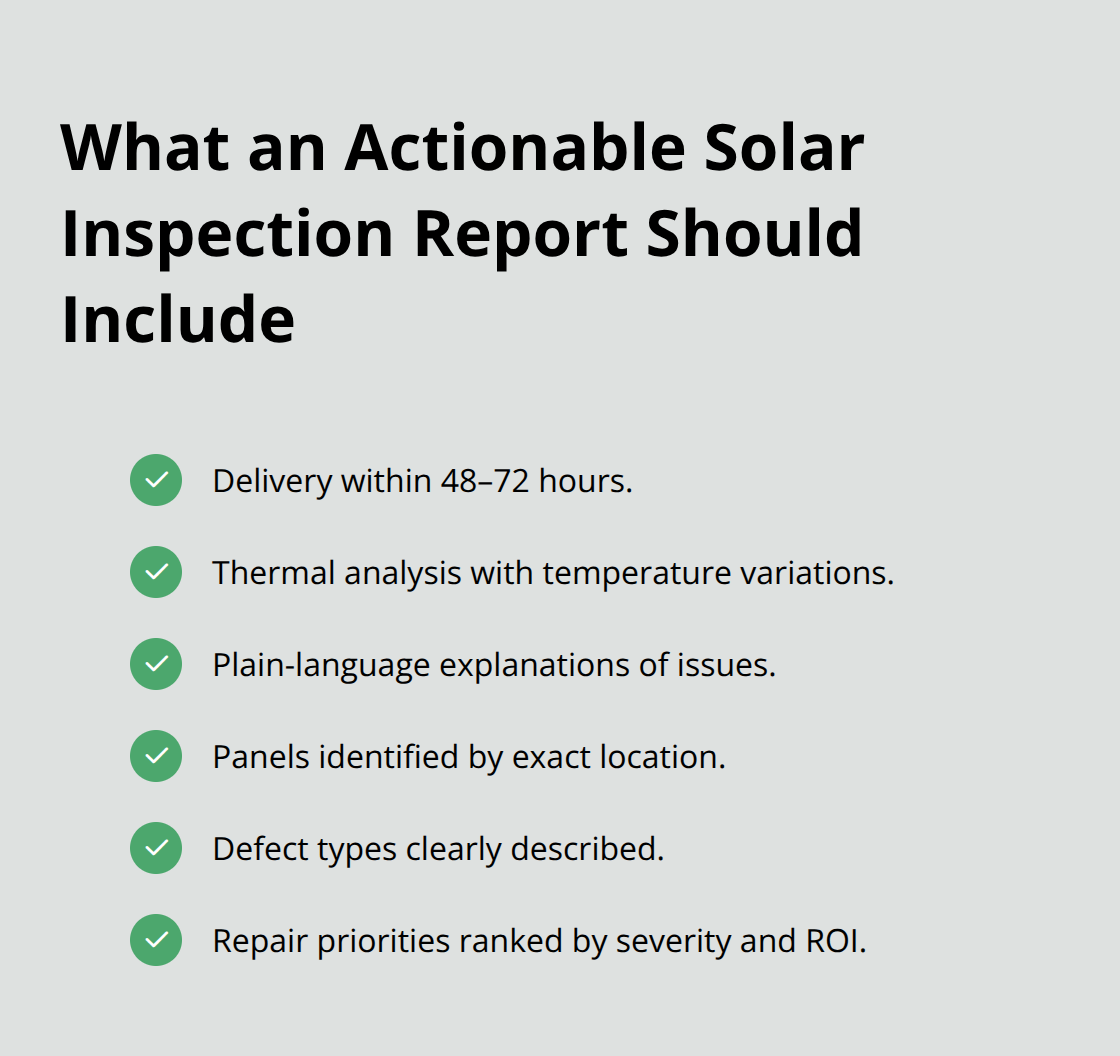
At IE Drone Services, we combine FAA-certified pilot expertise with high-resolution and infrared camera systems designed specifically for solar diagnostics. Our reports pinpoint exact panel locations, defect types, and repair priorities in actionable detail, helping you make informed decisions about maintenance and repairs without unnecessary spending.
Final Thoughts
Aerial solar inspection services deliver measurable returns that justify the investment immediately. A $300-800 inspection identifies $5,000-15,000 in efficiency gains or prevented degradation, and high-resolution thermal imaging reveals electrical faults that ground inspectors miss entirely. Systems larger than 15 kilowatts installed in high-soiling regions should schedule annual inspections as standard maintenance, since a single underperforming string costs thousands in lost energy production before anyone notices the output drop.
Detailed inspection reports create a maintenance history that tracks degradation patterns over time, allowing you to schedule interventions strategically rather than reactively. You avoid premature panel replacement, prevent warranty claim denials caused by unaddressed defects, and maximize the 25-30 year lifespan your system was designed to deliver. Solar owners who conduct regular aerial inspections maintain output levels 15-25% higher than those relying on visual monitoring alone.
Contact IE Drone Services to schedule your professional aerial solar inspection. Our FAA-certified pilots and high-resolution thermal camera systems deliver actionable reports within 48-72 hours, identifying specific panels, defect types, and repair priorities in plain language. Stop guessing about your system’s health and start making maintenance decisions based on precise data.